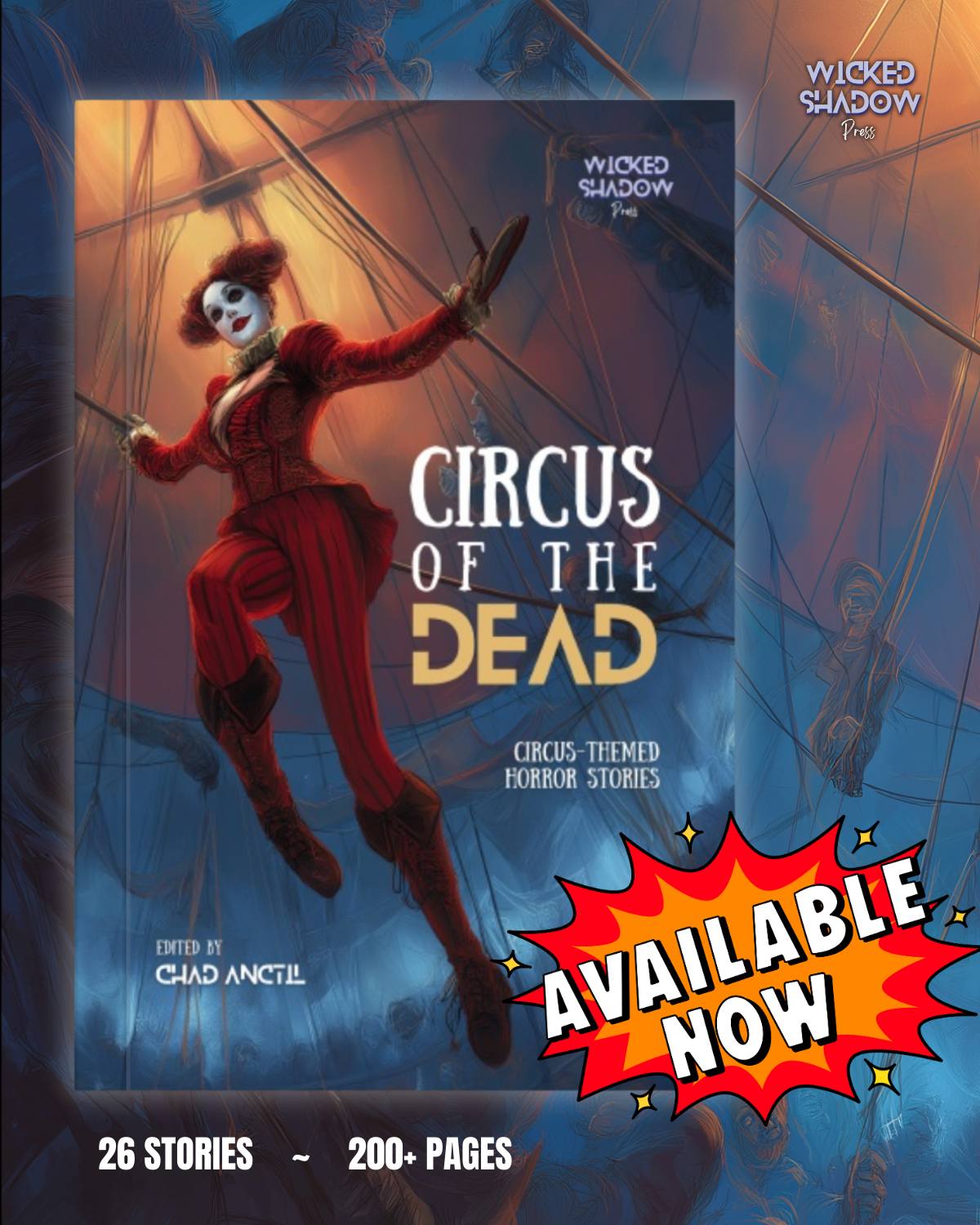
When Circus of the Dead was released by Wicked Shadow Press, it marked a major milestone for me—not just as a writer, but as an editor. It was my first time stepping into the role of anthology editor, and the experience proved to be one of the most challenging and rewarding of my writing career so far. While I’ve had the pleasure of contributing to numerous anthologies over the years, this was my first time overseeing the entire process: from concept to curation, from structural edits to the final table of contents.
It all started with a story of my own: Entry of the Gladiators, a twisted circus tale in need of a home. I approached Wicked Shadow Press, a publisher I’ve collaborated with for several years, with the idea of a circus-themed horror anthology. To my surprise, they not only loved the concept—they offered me the opportunity to serve as guest editor for the entire volume.
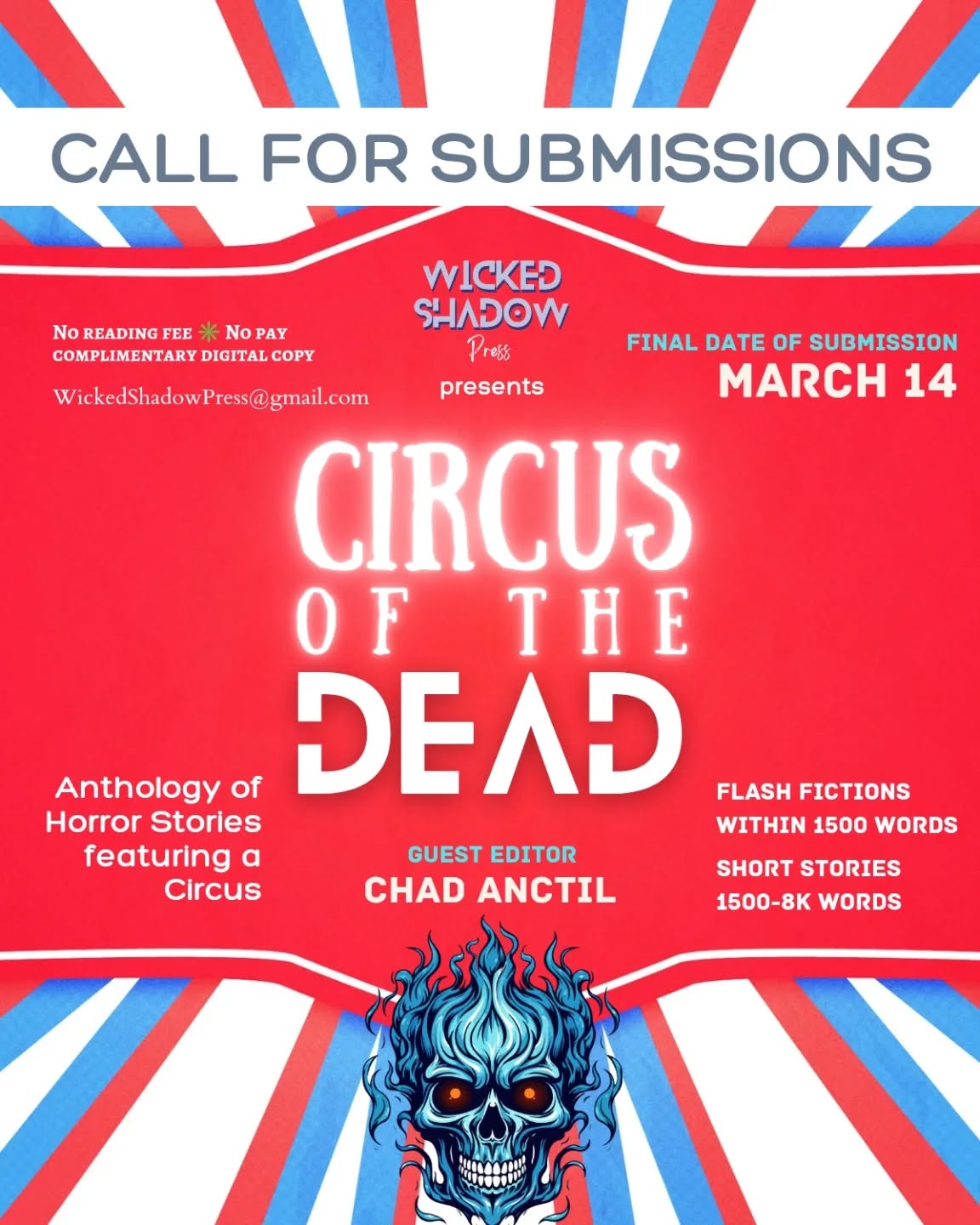
Once I accepted, the real work began. We discussed the project’s scope, timelines, and contracts—all the essential, if somewhat unglamorous, logistical steps. Things truly became exciting when the official call for submissions went out. I provided Wicked Shadow with what I wanted to see and they added their own flair, then they spread the word across social media. Submissions began arriving immediately—I think I had over ten on the first day alone.
Each submission was logged in a shared spreadsheet with details including author name, word count, and status. I read every submission in full—regardless of how it started. I made a point of giving every author a fair chance to engage me, even if the opening paragraphs were rough or slow to develop. I know from experience that some of the best stories take time to bloom.
To aid my process, I relied on a screen reader—Speechify—to listen to the stories aloud. This helped me catch issues I might have overlooked in silent reading, since our brains tend to autocorrect as we read. Listening forces me to focus on the rhythm, flow, and structure of the stories more carefully.
Each story received a score from 1 to 10, accompanied by detailed notes: how well it fit the theme, whether it needed extensive editing, if it overlapped with another story’s concept, and my overall impressions. I spent several hours each day immersed in these stories, often revisiting ones that lingered in my thoughts.
After the submission window closed, I completed my review of the full list—which comprised many dozens of stories. I’m not sure I can share the exact number, but suffice it to say, it was substantial. From there, I revisited the top-scoring entries, asking tough questions: Did the story align with the anthology’s vision? Did it hold up to multiple readings? Did it bring something unique to the table?
Selecting the final stories for inclusion was, without question, the hardest part of the process. Every submission represented an author’s time, effort, and creativity, and I deeply appreciated them all. But ultimately, the anthology had to reflect cohesion, quality, and thematic consistency. Some stories required more edits than I could reasonably accommodate. Others, while compelling, diverged too far from the theme—yes, even in a book titled Circus of the Dead, there were stories that didn’t involve circuses at all.
To writers submitting their work to future anthologies, here’s my one piece of editorial advice: polish your story thoroughly. Grammar, formatting, and adherence to submission guidelines matter. A brilliant concept undermined by poor execution will almost always miss the cut. And above all, stay on theme—especially when the title spells it out for you.
Once the selections were finalized, I sorted them into a dedicated cloud folder and told Wicked Shadow. Then came the editing phase—three rounds in total. I don’t use AI or tools like Grammarly (I have strong feelings about AI in creative spaces). My first edit was a broad pass, catching spelling and punctuation errors. The second was a more meticulous content pass, involving grammatical fine-tuning, word choice, and sentence flow. I tried to make minimal content changes, always striving to preserve each author’s voice and tone.
For the final round, I brought in my not-so-secret weapon: my wife Wendy. She’s been my editor and trusted reader for over a decade. No matter how careful I am, she always finds something I missed. Wendy conducted a full proofread of each story, focusing on punctuation and grammar, and I made the necessary revisions based on her recommendations. After that, I did one final read-through of each piece before giving the green light to the publisher.
During all this, the publisher was equally busy—designing the cover art, formatting the interior, and creating the great little illustrations that accompany each story. I also wrote most of the story blurbs—those short summaries that precede each piece—and reviewed the illustrations for tone and fit.
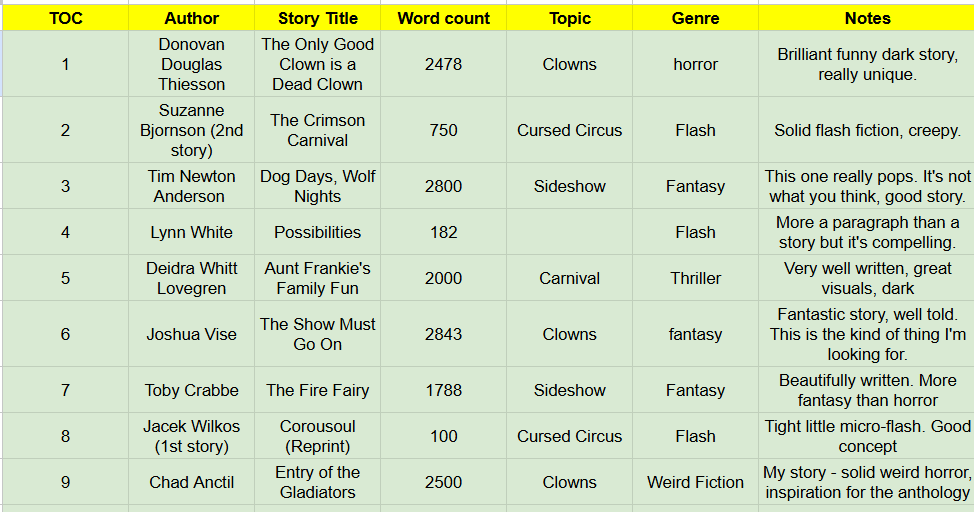
Arranging the table of contents became its own creative challenge. While the publisher offered to handle it, I wanted to be sure the order complemented the reading experience. I built another spreadsheet, organizing the selected stories by theme (clowns, cursed circus, sideshow terrors, etc.), genre (horror, thriller, surreal, atmospheric), and word count. I experimented with sequencing to avoid clustering similar tones or topics, ensuring a smooth narrative flow throughout the collection.
One final hurdle surprised me: writing the foreword. I initially wrote a fairly elaborate – and really pretentious – forward, but I didn’t like it, and neither did my editor; it just didn’t work. The final version you see in the book is simpler and more heartfelt: a reflection on the sinister charm of the circus, a genuine thank you to all these talented contributors, and an invitation to readers to enjoy the ride.
Once everything was submitted—final edits, foreword, and table of contents—we exchanged a few final notes with the publisher, and just like that, Circus of the Dead was born.
In the end, I want to share something extra with readers: a spoiler-free look at each of the stories selected for this anthology. What drew me to them, what made them stand out, and why they earned a place in the final collection. I hope this behind-the-scenes look offers a bit of insight into the editorial process, and maybe even encourages other writers to step into the editor’s chair one day. It’s hard work—but it’s also a rare kind of magic.
In TOC Order:
The Only Good Clown is a Dead Clown – Donovan Douglas Thiesson
This brilliantly subversive take on the “murderous clown” trope grabbed me immediately. The twist was so clever that I actually clapped when I got done reading the story, and I even told Wendy about it. It exemplifies exactly what I was hoping to achieve with Circus of the Dead: stories of circus horror that are dark and strange, somewhat familiar yet unexpected. I placed this story first in the anthology because it sets the tone perfectly. Buckle up—this ride was assembled in the dark, by drunk carnies.
The Crimson Carnival – Suzanne Bjornson
A tightly woven piece of flash fiction with a haunting atmosphere. Suzanne delivers a slow, creeping sense of dread within the classic “cursed circus” subgenre that is both subtle and effective.
Dog Days, Wolf Nights – Tim Newton Anderson
Another story that hooked me with a twist, and a not so subtle social commentary as well. The wrap-around connection of the first paragraph and the last were just a delight. This is beautifully written sideshow horror.
Possibilities – Lynn White
A short, mood-driven micro-fiction that lingers like the scent of sawdust and nostalgia in the big top. It’s more about feeling than plot, but its emotional undercurrent earned it a place here.
Aunt Frankie’s Family Fun – Deidra Whitt Lovegren
This was the first submission that made me sit up and say, “This has to be in the book.” I expected supernatural horror, killer clowns, and cursed big tops—but this visceral, violent, and gritty tale shocked me in the best way, reminding me of classic Rob Zombie; Think House of 1000 Corpses with a carnival twist.
The Show Must Go On – Joshua Vise
A standout concept I can’t explain without spoilers—but trust me, it’s brilliant. A completely original take on the clown story that is definitely not what you’re expecting, and it is executed flawlessly.
The Fire Fairy – Toby Crabbe
A lyrical fantasy tale, this story showcases a gentler but no less disturbing side of sideshow horror. Beautifully rendered. The visuals really captured me on this one, I felt like I was there in the tent with them.
Carousoul – Jacek Wilkos
Atmospheric and chilling in under a page. Jacek’s micro-fiction piece ends on a perfectly sinister note that cemented it’s place in the TOC.
Entry of the Gladiators – Chad Anctil
The seed from which this entire anthology grew. A personal piece I’m proud of—my own take on weird clown horror. I included it only after ensuring it didn’t take the spot of another deserving submission.
Ballet of the Dolls – James Dorr
A dark, enchanting tale of betrayal, dark magic—and chickens. James Dorr delivers a story as strange as it is compelling, with wonderful prose and a unique voice. I’ll admit I didn’t see where it was going until the end, and I loved that about it.
Dead Pegasuses – Lawrence Dagstine
At first, I wasn’t sure this one fit the anthology’s theme, but it haunted me. The surreal imagery, tragic tone, and quiet horror refused to let go. I’m glad I gave it a second look—I do feel it adds a haunting elegance to the collection.
The Witch and the Lich Lord – Jasiah Witkofsky
This one blew me away. Its sword and sorcery meets sinister circus, with rich worldbuilding and real menace. The story feels like a long-lost Robert E. Howard tale—definitely one of my personal favorites.
The Clowns of the Apocalypse – Andrew Kurtz
Initially uncertain about this one, I found myself thinking about it days later. Disturbing, inventive, and undeniably memorable.
13 Faces Underneath The Hat – Roberto Miguel A. Gaspar
This tale reads like a relic from the golden age of pulp horror—something you’d expect to see in Weird Tales circa 1927 across the fold from an H.P. Lovecraft story. Elegant, unsettling, and timeless. I was hooked on the first reading.
The Marionette’s Waltz – Suzanne Bjornson
This is a classic “intrepid reporter gets in too deep” tale with a satisfyingly creepy payoff. It was a bit predictable, but not in a bad way – the story may follow expected beats, but it plays them with finesse.
Cirque Sinful – Zoë Paige
This story is equal parts horror and oddly sexy – another ‘intrepid reporter investigates bad things’ type story, but a completely different vibe from the previous tale. The visuals and atmosphere of this one really sold it for me.
The Curse of Madame Serena – Kerry D. Brackett
Reminiscent of Shirley Jackson, this story isn’t overtly horrific, but it exudes dread. Moody, quiet, and deeply well-crafted, with a subtle social commentary mixed in.
Queens of the Air – Robb White
Wendy’s favorite—and for good reason. This beautifully constructed story delivers mystery, supernatural intrigue, and emotional payoff in equal measure. While not technically ‘horror’ it is a well written murder mystery with a thrilling climax. Elegantly done.
Sideshow – Cliff Hansen
This was exactly the kind of story I was hoping for when I started this project, and Cliff Hansen did not disappoint – unsettling, smart, and socially resonant. A quintessential sideshow horror tale.
Why I’m Afraid of Mimes – Tom Folske
Bizarre, sharp, and cleverly constructed. This is a weird little story about consequences that puts the reader in a very strange place – surrounded by mimes. Lots and lots of mimes.
Fritters – Ricardo D. Rebelo
What’s a circus horror collection without cannibal carnies? This story continues to remind me of a midwestern version of ‘Mrs. Lovett’s Meat Pies’ from Sweeny Todd.
In Two Minds – Chris Tattersall
Barely 200 words, yet it delivers a full narrative punch. A lesson in how micro-fiction can hit just as hard as longer works.
Emmett – James Stevens-Arce
This surreal reprint from 1976 is probably the weirdest story in the book—and I loved it. Disorienting, dreamlike, and completely original. I’m excited to give it a new audience nearly 50 years later.
Roll Up! Roll Up! – Kay Northbridge
My first perfect 10 on the spreadsheet. Gripping from the first paragraph, it takes the “cursed circus” trope and twists it into something fresh and unforgettable. It was really well written and the story just draws you in, it hooks you early and as soon as you understand what’s happening, it pulls you in more.
Clownshoes – Pat Harrigan
A masterclass in brevity. What Pat does with so few words is astonishing. Powerful and deeply disturbing.
A Letter Home – Lawrence Miles
This story had me laughing out loud—until it didn’t. It starts funny, even juvenile, but veers suddenly and violently into much darker territory, leaving a chill long after the final sentence. I placed it last for that reason: to leave the reader haunted.


 Visions of a Dark Horizon
Leave a comment