How it started:
I worked as the guest editor on a book in 2024-2025 called ‘Circus of the Dead’, published by Wicked Shadow Press. It was a fun, challenging experience editing the collection, and I really enjoyed working with the publisher, so I thought it was something I’d like to try again. About a year ago I sent Wicked Shadow a proposal for another collection: Ocean of the Dead. They have a long-established ‘Of The Dead’ series of books, so I thought a book of ocean horror in the same style would be a great addition to their catalog.
They loved the idea (yay!), but they had a whole slate of books already in their publishing pipeline, so we had to work out the right timing for ‘Ocean’. That window opened earlier this year, and we sent the call for submissions worldwide. I was clear what I wanted – unique stories of ocean horror, aquatic terror, sea monsters, megalodons, etc. Give me those good, dark, ocean nightmares, and give them your own twist.
Throughout the submission period, I only got a few stories, about twenty in total, which both worried and confused me. For ‘Circus of the Dead’, I got many dozens, a steady stream of stories throughout the entire submission window, so I wondered if my idea of ocean horror was somehow not resonating?
I emailed the publisher to check in, but I didn’t hear back. I was concerned the book might never get off the ground. It turns out the publisher got busy with another project and couldn’t send me the stories as they came in, so they sent them all at once!
I still remember; it was a Tuesday night, and I was performing with Providence Drum Troupe. I’m a professional puppeteer and street performer as well as an author, and we perform free shows for the community every week. I’m in the middle of a performance, puppeteering a 13-foot-tall pink furry puppet, when my phone starts BLOWING UP. It’s just buzzing, and buzzing, and buzzing, to the point where I’m afraid it’s broken, but I’m in the middle of a performance and can’t check it to see what’s happening. It buzzed like that for over 30 minutes! When I finally checked my phone, I saw that Wicked Shadow Press had sent me ALL the stories. So… Many… Stories. I was suddenly both thrilled and terrified, and my job as guest editor got a lot bigger.
Building the Book:
I use a detailed spreadsheet to track every story that comes in, including the story name, word count, and general theme. I score them on several categories, including how well they’re written, how much work it will take to get them ready for publishing, overall adherence to theme, and scare factor, which is subjective and can mean different things to different people. For a book called ‘Ocean of the DEAD’, obviously I didn’t want ‘romantasy’ stories.
I started reading submissions, at least eight to ten per day, and really thinking about them, scoring them objectively. I read them all, end to end, because I didn’t want to dismiss anything that started weak, in case the main story was really strong. Some stories instantly did not work; they weren’t related to the ocean at all, or else they were originally a non-ocean story that had a paragraph about some cursed bay stapled on after the fact – it’s easy to tell. Some stories required more edits than I could reasonably accommodate; they were good stories, but just too rough grammatically for me to take on. I did decline two stories that were obviously AI-generated (they literally left the prompts in the manuscript). Some stories were just automatically in; I didn’t even have to think about it; they just fit my vision for the book perfectly, and they got the golden buzzer after the first read-through.
Selecting stories for inclusion is incredibly challenging for me, because I’m a Pisces and hate disappointing people. Every submission represents an author’s time, effort, and creativity. Each story they send out into the world is a dream made manifest, and I deeply appreciate them all. But ultimately, the anthology has to reflect cohesion, quality, and thematic consistency. Lots of stories met those criteria, but many did not.
As I watched the word count of accepted stories climb, I started to worry about space. Wicked Shadow has a pretty specific maximum word count they expect for their books, and I was rapidly approaching that, so I reached out to see if they would be willing to split the collection into multiple books, as they had done for some of their other anthologies. I know it’s more work and more expense, but I didn’t want to leave any stories in the editing booth that I felt deserved to be in the Table of Contents. Happily, the publisher agreed, and so the two-volume set was born.

Twice the Books, Twice the Fun:
As soon as I got permission to create two books, I was relieved I could include all the stories I wanted, but it also meant I had a lot more work ahead of me. On top of editing all the stories for publication and coming up with the necessary ‘blurbs’ for each, I had to choose which stories went into which book, think about titles for each book, determine the TOC order, and write the foreword for each book. Side note – why is it so hard to write a foreword?
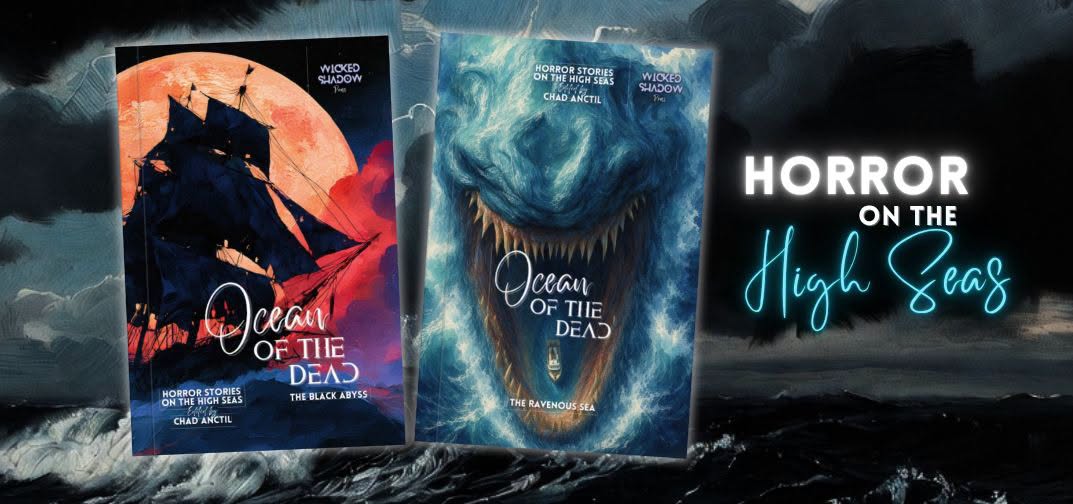
The stories I had selected ‘mostly’ fell into two camps, which essentially broke down to ‘scary ocean’ and ‘scary monsters in the ocean’. It took some tweaking, but I was able to create two volumes of similar size that fit those themes. The titles of ‘The Black Abyss’ and ‘The Ravenous Sea’ actually came to me during a run down by the ocean near my home in Rhode Island one foggy morning.
I genuinely feel like the Table of Contents for an anthology can make or break a book. The order of those stories can make a book more enjoyable or harder to read. String together too many very long stories, and the reader might start feeling bogged down. Put two stories back to back that have similar themes, and the reader might get confused. If you kick off the book with a slow-burn story, the reader might not be engaged. The last story in the book is probably what the reader will remember most, so it has to be memorable. There’s a lot of thought that goes into it, and it took me a while to sort it all out. I hope I did a good job and that my readers approve.
It all comes together:
Editing definitely takes the most time. I do a content edit to make sure everything in the story makes sense and that there are no glaring inconsistencies. I do some research if a story mentions specific depths, locations, or other bits of information that, if obviously incorrect, can pull a knowledgeable reader out of the story. I then do a full line edit, just to make sure all the spelling and punctuation are correct, basics like that. I do NOT put the stories through any kind of ChatGPT checks. I do not use generative AI for anything, and I will not upload other authors’ stories into the machine for their words to be stolen.
Finally, after I have gone through all those edits, I give the stories to my personal editor and writing good luck charm, my wonderful wife Wendy, who goes through them all and points out all the mistakes I made. Seriously – she’s a much better editor than I am when it comes to grammar and punctuation, and she catches subtle errors that I miss. I call it the ‘polish pass’.
The last thing I do is write the forewords and little one-sentence blurbs for each story that Wicked Shadow likes to put at the start of all the stories in the book.
The foreword- why is that so hard? It sounds simple, but it is not. That’s probably my least favorite part of the process for some reason, and I had to do it twice for this project, since each book had its own unique theme.
The blurbs are challenging, but fun – they’re just a little one-sentence teaser for each tale, no spoilers, but enough information to whet the readers’ appetite.
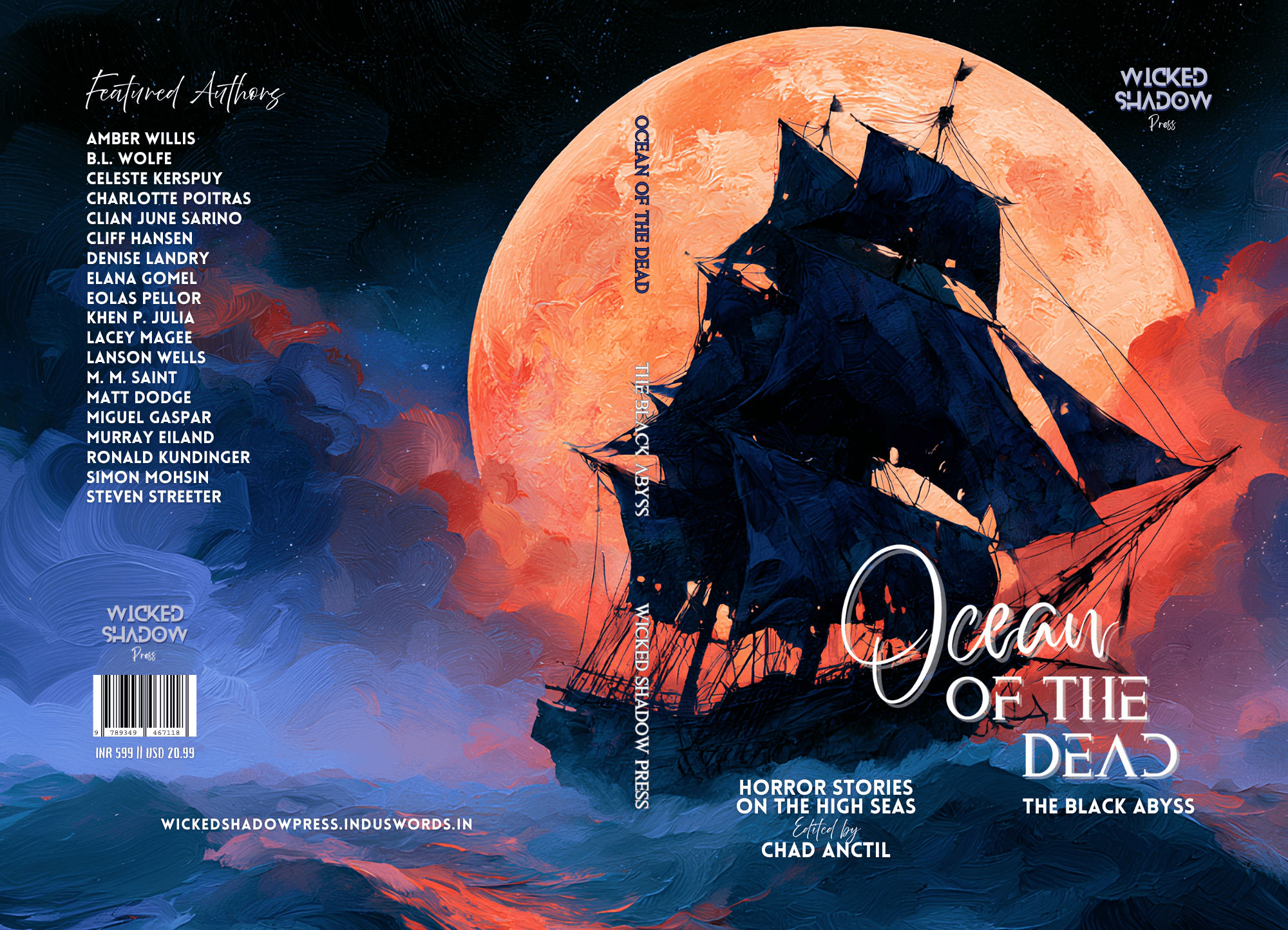
And that’s it. The stories are publication-ready; the titles are there, the TOC is complete, the forewords are written, the blurbs are done, and I make some general suggestions about the cover art the publisher can give to their design team. I have literally no say in the cover art, but that’s OK. Once that’s all done, it’s with the publisher, and I just wait anxiously for the final versions and hope that the readers and all the authors who have trusted me with their work are happy with the final result!
Here is my breakdown of all the stories I chose and a little bit about why:
Ocean of the Dead: The Black Abyss
Seashell, he said, by Charlotte Poitras, is an unsettling little piece of microfiction that I knew was the perfect bit of prose to kick off this book. It takes a beloved children’s game and turns it into something frightening in only 200 words. It absolutely put a smile on my face the first time I read it.
Eusterra Hesct by Miguel Gaspar. A beautiful, chilling tale of a kingdom in decline that echoes The Masque of the Red Death. The worldbuilding, visuals, and overall tone hooked me from the first read-through.
El diario del Padre Severino Sánchez by Clian June. This story grabbed me with its characters and its conflicts. There’s a tremendous amount of tension even before the big supernatural payoff, and it builds to a darkly satisfying conclusion.
Cheating Death by Amber Willis. This story was a delight. The ‘playing a game against Death’ trope, but twisted into something macabre and, ultimately, horrifying. And all in under 500 words. Wonderfully done.
Hands Beneath by Denise Landry. This is a beautiful and disturbing story of grief. You truly feel the main character’s sorrow, and the visuals once she gets out onto the water—once the sea calms and things begin to happen—are terrifying: a truly excellent ghost story, and something more.
Little Fish by Elana Gomel is a curious addition to this collection. As a member of GenX, I’m very familiar with the song this title references, and Elana Gomel does a magnificent job blending pregnancy horror with changeling tropes and, ultimately, bringing in a reference to Clark Ashton Smith’s Tsathoggua.
Horizon by Matt Dodge is ocean horror and weird fiction combined into the ultimate ‘Don’t go off the edge of the map’ story. The fanatical captain really brings the story’s intensity to life.
Shark Bait by Steven Streeter. This story may be the only one in The Black Abyss with a shark attack, but I included it because the shark isn’t the villain here. A shark’s gonna do what a shark’s gonna do. The real villain in this story is something far worse—a desperate man.
Near the Edge of a Green Speckled Sea by Ronald Kundinger. This was one of the first stories I gave my ‘golden buzzer’. From the beautifully evocative title to the story of grief and loss that pulls you in and makes you feel for these characters, The Green Speckled Sea is a wonderfully woven fable that packs a powerful punch.
The Deep Decides by Celeste Kerspuy is a dark folk tale that really stuck with me. The world the author weaves here has a depth and texture that feels real, and it holds a sadness that lasts long after the story ends.
The Sacrament by Lacey Magee. A strong ghost ship story. I enjoyed how the author built up the tension using the old log book entries, and by the time the salvage crew realizes something is wrong, it’s too late.
The Water Gods of Mars by Cliff Hansen. The only science fiction story submitted, but it’s really interesting and well-paced. There’s a great cosmic horror spin to this tale, and imagining those vast oceans across Mars’s surface is a great visual.
The Tangle by Simon Mohsin. This is a fascinating ghost story from a culture I had very little insight into – which is one of the things I loved about editing these books! Bengali, Arakanese, and Portuguese spirits locked in an eternal struggle out on the waters they all shared, witnessed by fishermen who wanted no part in their argument!
The Watchman by Eolas Pellor. I was unsure where this story was going when I started reading it. It starts like a typical ‘big city guy gets sent to a small secluded town to ‘help’ the people there’ story, and I enjoyed the teases of maybe something supernatural going on. The story does not go where you expect it to, in the best way, and I was thrilled with the payoff of this one—a lot of fun.
The Kept by M. M. Saint. This is a somewhat weird deep-sea, possibly zombie horror that kept me on my toes. A lot is going on here, with mystical brine pockets and a research team and a curse, and of course human greed. I really enjoyed it.
Lost Souls by B.L. Wolfe. This is a special kind of ocean horror, and it’s so well written. The story is short, but intense and disorienting, and the ending is suffocating, like you’re trying to get to the surface, but you know you’re going to run out of breath before you reach it.
Settling the Account by Khen P. Julia is a great folk horror about greed and obsession as much as it is about sea monsters. The setting and story are unique, and I loved how the author tied it all together at the end.
The Gull Bride by Lanson Wells. Another story I knew was in the collection as soon as I read it. It feels like Arthur Machen, with a fantastic weird fiction vibe that keeps the reader engaged and unsettled.
Melody of the Waves by Murray Eiland. This story feels like Lovecraft, with a professor researching things he probably shouldn’t, people who came back from the sea wrong, and a strange cult worshipping something ancient and unspeakable.
The Ulungu’s Mirrors by Celeste Kerspuy. The second story by Celeste in this collection, and a strong folk horror about a sea monster, of sorts. The monster isn’t the antagonist in this case; it is simply a mirror to the darkness within us all, and the story builds on that idea beautifully. As a side note: when I’m reviewing stories, I don’t look at the author names, because I know a lot of horror writers and don’t want to be unduly influenced into including a story just because a friend or acquaintance wrote it. Celeste getting two flash fiction entries into this book just means I really like the way she writes, and her stories fit the theme I was going for. And for clarity – Wicked Shadow allows up to two flash fiction submissions for their collections, and they gave me no limitations on how many could be in the book.
Ocean the Dead: The Ravenous Sea
Nameless One by Andrew J Lucas was a complete surprise. Somali pirates crossed with Lovecraft and the terrifying undead becomes a mix I would never have imagined, but it’s a fantastic way to kick off a book about monsters. Compelling and incredibly cinematic, I would love to see a feature film of this one.
Afraid of Fire by H J Dutton. This started as an ordinary revenge story-the main characters’ father and other fishermen were attacked by something in the deep, and our main character is headed out there with his trusty harpoon to kill it. The author takes this trope in a completely unexpected direction, and the ending is horrific in its own unique way.
Canso Queen by Chris Turner is a tight story about a dredging crew that uncovers something terrible in the depths. I love the imagery, the descriptions of the creatures, and the intensity as the story builds. The climax is pure sea monster terror.
The Chosen One by Efrain Nadal De Choudens is weird and wonderful. The story reads like a fantasy or fairy tale, but the details make it so unsettling that it pushes into horror. The way the author describes the creatures gives them an uncanny, even sinister beauty that I really enjoyed.
The Bones of Behemoth by John A. DeLaughter had me hooked at the title. This story has it all: government conspiracies, secret missions, horrible monsters, maybe aliens? And of course a kaiju. The author creates a complete, detailed story, but also leaves the reader wanting more.
The Blue Men by Carlotta Leone. This one is based on Scottish folklore I had never heard of, but I am now fascinated by! The Blue Men of the Minch are said to be violent, storm-raising water spirits, and I love this story of a modern investigation into an ancient legend that might not be legend after all.
The Steel Tomb by Ricardo D. Rebelo is a tight Lovecraftian tale of the things that lurk in the deep. An anti-whaling crew facing off against whalers is a great setting for creating literary tension, but add in eldritch horrors from the depths that have their own designs on humanity, and you get great weird ocean horror.
The Grasping Deep by Jacob Peyton made me laugh out loud as I read it. It’s horror – it’s definitely freaky, gross horror, and the visuals of the marauding octopuses are so nasty – but as a former submariner myself, serving on fast-attack submarines for years, this one just had me rolling in a good way.
Sea Sacrifices by David O’Mahony was wholly unexpected, and at first I wasn’t sure it fit the theme; the opening was more ‘Terror of Dracula’ than ocean horror. As the story unfolded, however, the importance and power and danger of the sea became its own character, and the sacrifices in the title go much deeper than you’d expect.
Janelle is still Janelle by Donovan Douglas Thiesson was the first story to make me say ‘What the hell did I just read?’ and then made me go back and read it again. Donovan is an amazing author, and I am proud to have been in a few books with him, so I was thrilled to see that he submitted a story to this collection. This story is so strange, so weird, but also beautiful in a way – as much as ‘turning your girlfriend into a giant squid’ can be beautiful, at least.
The Sirens’ Call by Tyler Whetstone is a delightful little micro-fiction that starts as a fun ‘Little Mermaid’ trope, but then the terrible reality hits, and it is horror through and through.
Oceans of Karma by Andrew Kurtz was both gruesome and disorienting from the first paragraph. The horrors are unrelenting, and the reasons and mechanisms for them are unclear until the end, which ties the whole story up in a most satisfying way. A wild, gory ride start to finish.
Bloodlington Pier by Tony Earnshaw is a hell of a story. It reminded me of the fantastic Irish/UK horror movie Grabbers. Just a couple o’ blokes fishing and drinking some pints on the pier, and all hell breaks loose. The little coda at the end is such a deep-cut reference to old Navy sea-monster history and the USS Stein; I almost feel like the author added it in there just for me.
The Last Dive of the Marauder by Celeste Kerspuy is an amazing story. The worldbuilding of this strange, alien, post-apocalyptic Earth and its deadly creatures, the hints of something far worse just below the surface… The reveal that the devastation was caused by man’s folly, our desire to tame the untamable, it all flows together so well. This story had me thinking about it long after I finished reading, and that’s why I needed to put it last. To give the reader that gift of a story so tightly woven and intriguing, you can’t stop thinking about it and wanting to hear more about the mad, beautiful, deadly world it describes.
How to Purchase:
If you’ve made it this far, you’re probably interested in getting your very own copy of this amazing collection! Here’s where you can buy it:
Volume: THE RAVENOUS SEA
Book: https://www.lulu.com/…/paperback/product-57q2yr9.html
ePub: https://www.lulu.com/…/ocean…/ebook/product-yvewg72.html
Volume: THE BLACK ABYSS
Book: https://www.lulu.com/…/paperback/product-e7qyw96.html
ePub: https://www.lulu.com/…/ocean…/ebook/product-57q2849.html
Leave a Reply